墨白
墨白 When someone discovers a new mole on their body, the first reaction of many people is to “get it removed as soon as possible.” However, when it comes time to actually go to the hospital and make an appointment, they realize they face a dilemma: should they visit the Dermatology department, the cosmetic surgery department, or the plastic surgery department? There is no standard answer to this question, but understanding the differences between these departments can help you avoid taking unnecessary detours.
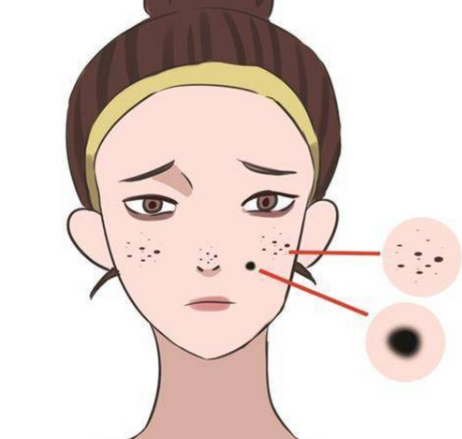
Dermatology and cosmetic clinics approach the treatment of moles from different perspectives.
On the surface, both of these departments can help you remove moles, but their approaches are fundamentally different.
The primary task of Dermatology is “diagnosis”. A doctor’s first step is not to pick up a scalpel, but to determine whether there is anything wrong with a mole—using a dermatoscope to check whether its edges are regular, whether the color distribution is uniform, and whether it has changed recently. If removal is deemed necessary, the removed tissue will also be sent for pathological examination to confirm whether it is benign or otherwise.
The cosmetic surgery department (or the cosmetic surgery section within the plastic surgery department) places “effectiveness first.” The doctors’ primary concern is: after removing a certain part of the body, can the scar be minimized as much as possible? And after healing, will the skin look natural? For moles that are located on the face or neck and are easily visible, the suturing techniques used in cosmetic surgery are indeed much more precise than those in general surgery.
Therefore, it’s not about which department is “better,” but rather about what your specific needs are.
In these cases, it is advisable to consult a Dermatology specialist first.
If any of the following changes have occurred to your moles recently, the first place you should go is to a Dermatology clinic:
- The color deepens, or areas of varying shades appear within the same mole.
- The edges become irregular, resembling serrated edges or having blurred contours.
- It has increased significantly, especially in the past few months, when it grew at a rapid pace.
- It begins to itch, bleed, form scabs, or cause discomfort upon touch.
- There is a history of skin cancer in the family.
These are all signs that a Dermatology doctor needs to evaluate first. It is essential to determine the nature of the lesion before proceeding with any treatment. If you simply go to the cosmetic department and say, “I want this mole removed,” the doctor can certainly assist you with the procedure, but if there are any underlying issues, you might miss out on the most critical diagnostic steps.

In these cases, you can directly consider consulting a dermatology department.
If your mole remains stable over time, has a regular shape, and a uniform color, but simply doesn’t look pleasing to you, then visiting a cosmetic or plastic surgery clinic is a completely reasonable option, especially in the following situations:
- If moles appear on the face, at the corners of the eyes, next to the nostrils, or around the mouth, people tend to be particularly concerned about the issue of scars.
- If the diameter of a mole exceeds 5 mm, conventional lasers may not be able to remove it completely, and surgical removal is required.
- Protruding moles, such as papillary moles, require more complex wound healing after removal compared to flat moles.
- I had it treated with laser before, but it recurred; I suspect that the root cause was not completely removed.
The advantage of Dermatology surgeons in dealing with facial moles lies in their suturing techniques. They create incisions along the natural lines of the skin (medically known as Langer lines) and use sutures that are finer than human hair to perform intradermal closures. As a result, the scars left after healing are usually very faint. For areas on the back or arms where appearance is not a concern, simple excision by a Dermatology specialist is sufficient.
Laser removal of moles vs surgical excision – which method is better?
This is a question that many people care about. Simply put, both methods have their own applicable scenarios:
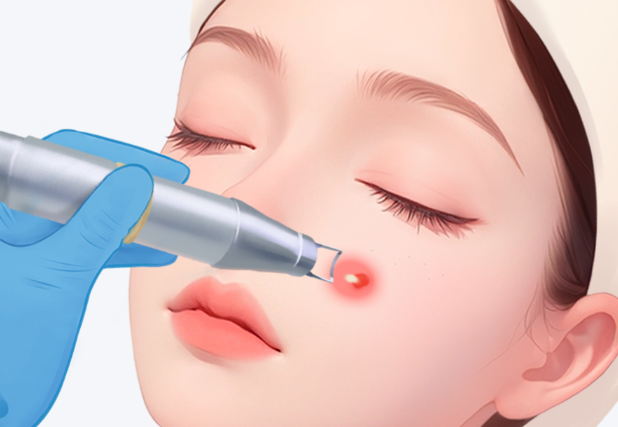
Laser ldm: Suitable for flat moles with a small diameter (usually within 3mm) and located in the superficial layer of the skin. The procedure is simple, recovery is fast, and no stitches are required. However, for deeper pigmented moles, the laser may only remove the surface layer, leaving the root intact, which can lead to recurrence. Once a mole recurs, it becomes even more difficult to treat.
Surgical removal: This method allows for the complete elimination of the mole, and the tissue can be sent for pathological examination, making it currently the most reliable approach. The downside is that it will result in a linear scar, whose length is approximately 2 to 3 times the diameter of the mole. If performed by a plastic surgeon using cosmetic suturing techniques, the scar will be much finer, but it will still be present.
If the diameter of a facial mole exceeds 5mm, most doctors will recommend surgical removal rather than laser treatment, as it is difficult to completely remove a mole of this size using lasers in one session.
Before removing a mole, this step is essential.
No matter which department you ultimately choose, there is one step that I strongly recommend not to skip: a dermatoscopy.
A dermoscope is a tool that combines a magnifying lens with side illumination, allowing doctors to clearly see the underlying structure of moles and determine whether they exhibit any malignant characteristics. Many moles that appear ordinary may actually have problems when viewed under a dermoscope. Conversely, some moles that look quite alarming turn out to be completely benign after being examined with a dermoscope, so there’s no need to worry.
The cost of this examination is not high; usually, it only costs a few hundred Taiwanese dollars. However, it can help you make the most informed decision possible.
How much does it cost to remove a mole?
The cost varies significantly and depends on several factors: the size of the mole, the department chosen, the level of the hospital, and whether a pathological examination is required.
For reference only: The removal of small moles (under 5 mm in size) through Dermatology procedures costs approximately 500 yuan or more; in Plastic Surgery, due to the higher costs associated with techniques and materials, the fee usually starts from 1,000 yuan. If the mole is larger or located in a complex area, the cost will increase significantly. The cost of pathological testing is additional, but it is not advisable to cut corners on this expense.
The cost for removing a single mole using laser treatment is relatively low, starting from 300 yuan. However, if multiple treatments are required, the total cost may not necessarily be lower than that of surgical removal.
The exact cost can only be determined after a face-to-face consultation, as the conditions vary greatly from person to person.
How should I take care of my skin after having a mole removed?
The quality of postoperative care directly affects the final outcome.
Precautions after surgical removal: Keep the wound dry and attend follow-up appointments for dressing changes on time. For facial surgeries, stitches are usually removed within 5 to 7 days, while for surgeries on the torso and limbs, it takes approximately 10 to 14 days. After the stitches are removed, continue using scar-reducing ointments such as silicone-based products and take proper sun protection measures for at least 3 months.
After ldm with laser: During the scabbing period, do not try to remove the scab forcibly; let it fall off naturally. Before the scab falls off, avoid contact with water and do not apply makeup. After the scab has fallen off, continue to protect your skin from the sun. It usually takes 1 to 3 months for the skin color to return to normal and become ILCHI with the surrounding area.
There is one aspect that many people overlook: ultraviolet rays can cause newly formed skin to accumulate pigments, resulting in the appearance of spots. Sun protection is not just about “whitening” the skin; it is also an essential step in managing scars and pigmentation.
In summary: Choose the department that best suits your needs.
Let’s simplify the choices:
If a mole shows any abnormal changes, or if it is uncertain whether it is benign, it is advisable to visit a Dermatology specialist first for an evaluation and diagnosis.
It has been confirmed that the mole is benign; the main concerns are whether the scar will be noticeable and whether the treatment results will be satisfactory. In such cases, you can directly consult a plastic surgeon or a dermatologist specializing in cosmetic treatments.
If you’re not sure which option to choose, it’s advisable to first visit a Dermatology department for a dermatoscopy. After the doctor’s evaluation, if cosmetic suturing is recommended, you can then proceed with a referral or consult a plastic surgeon.
Removing ldms is not as complicated as one might think, but for many people, advertising can easily influence their decisions. Seeing slogans like “Painless ldm removal without scars” can be very tempting, only to result in spending extra money for subpar results. Understanding the differences between various medical departments is actually the most efficient way to avoid such issues.